
How to Identify and Date Vintage Broyhill Furniture: A Collector’s Guide to Brasilia, Sculptra, and Mid-Century Lines
Vintage Broyhill furniture has become increasingly sought after by collectors and mid-century modern enthusiasts, yet identifying authentic pieces and pinning down their production dates can challenge even experienced buyers. We’ve been manufacturing quality furniture since 1926, and our archive of designs spans decades of American home furnishing history.
Whether you’ve inherited a piece, found one at an estate sale, or are actively hunting for vintage Broyhill furniture to complete a collection, knowing how to read the clues left by our craftsmen will help you authenticate what you own and understand its place in our design timeline. This guide walks through the markings, construction details, and catalog references that reveal a piece’s age and originality.
Reading Broyhill Labels, Tags, and Stamps
The fastest way to confirm a piece’s authenticity is to locate the original manufacturer’s mark. Most Broyhill furniture carries a paper label, metal tag, or ink stamp on the back, underside, or inside a drawer.
Paper labels from the 1950s through the 1970s typically include the Broyhill name, the line or collection name, and sometimes a style number. Earlier pieces may show ‘Broyhill Premier’ or ‘Broyhill Lenoir House,’ reflecting brand divisions we used before consolidating under the Broyhill name. Metal tags—small brass or aluminum plates riveted to the frame—were common on upholstered pieces and often include a serial or lot number that corresponds to production records.
Ink stamps, usually found on the underside of case goods, can be harder to read after decades of wear but often show a date code or inspector’s mark. If the label is missing entirely, look for a stamped number on drawer bottoms, the back panel, or inside the cabinet frame—these factory marks were applied even when a paper label was also present.
Identifying Iconic Collections: Brasilia, Sculptra, and Emphasis
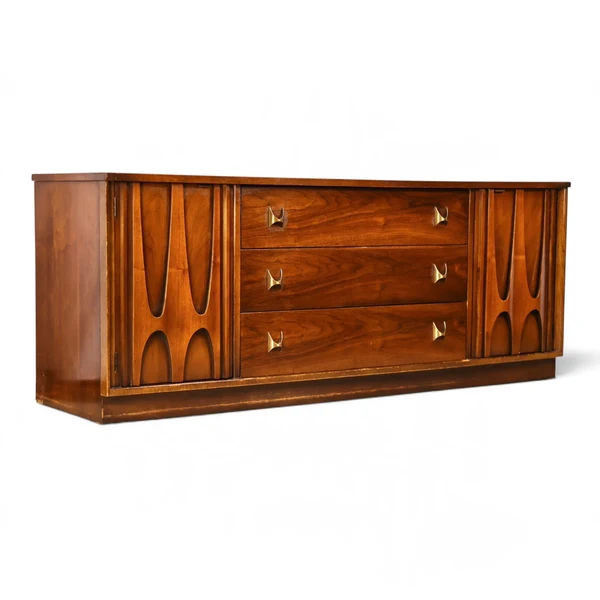
Certain Broyhill lines have become landmarks in mid-century furniture design, and each has distinctive visual signatures that make identification straightforward once you know what to look for. The Brasilia collection, introduced in 1962, is immediately recognizable by its angular walnut veneer, canted legs, and geometric drawer pulls—often brass or brushed metal in a trapezoidal shape.
Sculptra, released in the mid-1960s, features sculptural arched drawer fronts and a softer, more organic silhouette than Brasilia’s sharp lines. Emphasis, another highly collectible line from the same era, uses richly grained walnut with slim tapered legs and minimalist hardware. Each of these collections was produced for several years, so pinpointing an exact date requires cross-referencing the label’s format and any visible date codes with catalog records.
If you’re comparing pieces from different eras, note that our design language evolved—earlier 1950s work tends toward traditional American forms, while the 1960s and early 1970s reflect the mid-century modern aesthetic that defines most sought-after vintage Broyhill furniture today.
Construction Clues: Joinery, Hardware, and Materials
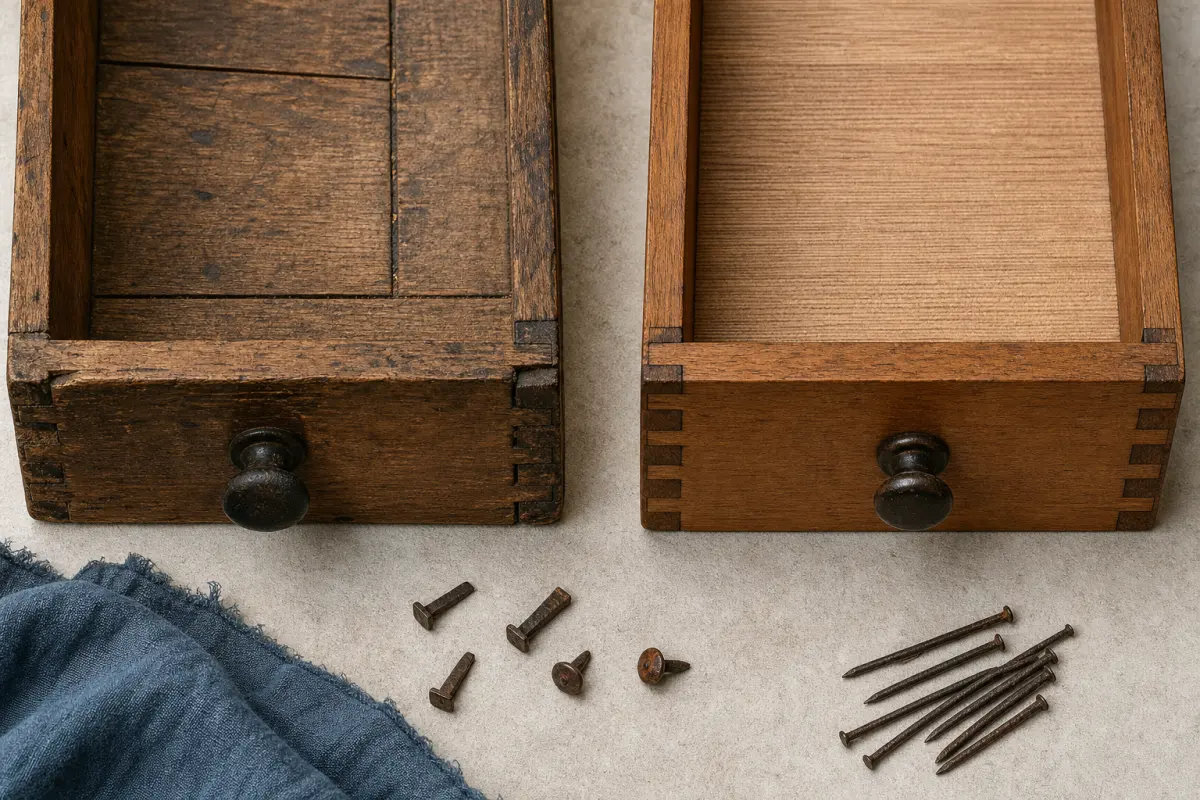
Beyond labels, the way a piece is built offers reliable dating evidence. Dovetail joints—visible where drawer sides meet the drawer front—are a hallmark of quality construction and can hint at era: hand-cut dovetails with slight irregularities suggest pre-1950s work, while machine-cut dovetails with uniform spacing are typical from the 1950s onward.
Hardware styles also changed over the decades. Brass pulls and escutcheons were common in the 1940s and early 1950s, giving way to sleeker pulls in brushed metal, teak, or molded plastic during the 1960s. Original hardware will show wear patterns consistent with the rest of the piece—if pulls look brand new on an otherwise aged dresser, they may be replacements.
Veneer quality and type matter too. High-grade walnut and pecan veneers were signatures of our mid-century lines, applied over solid hardwood frames. If you see particle board or MDF core, the piece is likely from the 1980s or later. According to Wikipedia’s overview of veneering techniques, the shift from solid wood to engineered cores became widespread in American furniture manufacturing during the late 20th century, so core material alone can bracket a piece’s age within a decade or two.
Using Catalogs and Online Resources to Confirm Dates
Once you’ve gathered physical evidence—label details, construction type, design features—the next step is cross-referencing with period catalogs and collector databases. Original Broyhill catalogs from the 1950s through the 1970s are archived by collectors and sometimes available through auction sites or mid-century furniture forums.
Catalog pages show each line’s full range, complete with style numbers, dimensions, and finish options, making it possible to confirm that your piece matches a documented offering. Online collector communities and vintage furniture reference sites have compiled databases of Broyhill lines, including production date ranges and known variations. If your piece shows features that don’t match any catalog entry—mismatched hardware, an unusual finish, non-standard dimensions—it may be a custom order, a factory second, or a later reproduction.
For discontinued collections that remain popular among collectors, our resource on discontinued lines explains why certain designs were retired and how production changes over time affect collectibility and value today.

Spotting Reproductions and Married Pieces
As demand for vintage Broyhill furniture has grown, so has the number of reproductions and ‘married’ pieces—authentic components combined with non-original parts. Reproductions often mimic the overall look of a classic line but cut corners on joinery, use lower-grade veneers, or apply a finish that doesn’t match period techniques.
One telltale sign is overly uniform stain color—authentic mid-century finishes show slight variation in tone across a piece due to the natural grain of the wood veneer. Married pieces are trickier: a dresser might have original drawer boxes but replacement pulls, or a bedroom set might combine authentic nightstands with a later headboard that was never part of the original line.
When evaluating a set, check that all pieces share the same finish color, hardware style, and construction details. Mismatched elements aren’t always a dealbreaker—many collectors accept replaced hardware if the rest of the piece is sound—but knowing what’s original helps you assess value and authenticity accurately.
Building Your Vintage Broyhill Knowledge
Authenticating and dating vintage Broyhill furniture becomes easier with practice, and each piece you examine adds to your understanding of our design evolution and manufacturing history. Whether you’re furnishing a home with mid-century pieces or building a collection, knowing how to read the physical evidence—labels, construction, materials—ensures you’re investing in genuine examples of American furniture craftsmanship.
As you explore different lines and eras, you’ll start to recognize the subtle differences that distinguish a 1950s traditional piece from a 1960s modernist icon. The Attic Heirlooms collection, for instance, represents a later chapter in our story, blending rustic charm with updated construction methods. Each collection reflects the design priorities and manufacturing techniques of its time, making vintage Broyhill furniture a tangible record of decades of American home life.
Notes
Check the back panel of case goods, the underside of tabletops, inside drawer boxes along the bottom or sides, and underneath upholstered seats. Paper labels are often glued to these hidden surfaces, while ink stamps may appear directly on the wood. If a drawer is removable, look on the bottom of the drawer itself and on the cabinet frame where the drawer sits.
Brasilia pieces feature angular walnut veneer, canted legs, and geometric brass or metal pulls, often with a trapezoidal shape. Sculptra has sculptural arched drawer fronts and a softer, more rounded silhouette. Both lines were produced in the 1960s, so check for a label inside or on the back that names the collection—many pieces were marked with the line name alongside the Broyhill brand.
Collectible mid-century lines like Brasilia, Sculptra, and Emphasis have appreciated significantly as demand for authentic mid-century modern furniture has grown. Condition, originality, and completeness of sets all affect value. Pieces with original hardware, intact labels, and minimal damage command the highest prices, while refinished or repaired items typically sell for less.
Original replacement parts for discontinued lines are rarely available from the manufacturer, but specialty hardware suppliers and mid-century furniture restorers sometimes stock period-correct pulls and hinges. Online marketplaces and collector forums are also good sources for salvaged hardware from pieces beyond repair. Reproduction hardware exists for some popular lines, though it may not match the exact finish or weight of the original.
Broyhill Premier was a higher-end division we used in the mid-20th century, typically featuring upgraded materials, more intricate joinery, and limited-production designs. Regular Broyhill lines were more widely distributed and often used simpler construction methods. Both divisions produced quality furniture, but Premier pieces are generally rarer and more sought after by collectors today.
Look for overly uniform stain color, a finish that feels thicker or glossier than surrounding wood, and sanding marks that don’t follow the grain. Original finishes develop a patina and show subtle wear in high-use areas like drawer fronts and tabletops. If the piece smells strongly of solvents or fresh lacquer, it was likely refinished recently. Check inside drawers and on unexposed surfaces—if those areas show a different finish or color, the exterior has been reworked.